Showing posts with label Q and A. Show all posts

Tuesday, January 12, 2010

Who was Cain's wife? Was Cain's wife his sister?

The Bible does not specifically say who Cain’s wife was. The only possible answer is that Cain's wife was his sister or niece or great-niece, etc. The Bible does not say how old Cain was when he killed Abel (Genesis 4:8). Since they were both farmers, they were likely both full-grown adults, possibly with families of their own. Adam and Eve surely had given birth to more children than just Cain and Abel at the time Abel was killed. They definitely had many more children later (Genesis 5:4). The fact that Cain was scared for his own life after he killed Abel (Genesis 4:14) indicates that there were likely many other children and perhaps even grandchildren of Adam and Eve already living at that time. Cain's wife (Genesis 4:17) was a daughter or granddaughter of Adam and Eve.

Since Adam and Eve were the first (and only) human beings, their children would have no other choice than to intermarry. God did not forbid inter-family marriage until much later when there were enough people to make intermarriage unnecessary (Leviticus 18:6-18). The reason that incest today often results in genetic abnormalities is that when two people of similar genetics (i.e., a brother and sister) have children together, there is a high risk of their recessive characteristics becoming dominant. When people from different families have children, it is highly unlikely that both parents will carry the same recessive traits. The human genetic code has become increasingly “polluted” over the centuries as genetic defects are multiplied, amplified, and passed down from generation to generation. Adam and Eve did not have any genetic defects, and that enabled them and the first few generations of their descendants to have a far greater quality of health than we do now. Adam and Eve’s children had few, if any, genetic defects. As a result, it was safe for them to intermarry.

Taken from http://www.gotquestions.org/Cains-wife.html by Got Questions Ministries

Monday, December 28, 2009

What sort of New Year’s Resolution should a Christian make?

The practice of making New Year’s resolutions goes back over 3000 years to the ancient Babylonians. There is just something about the start of a New Year that gives us the feeling of a fresh start and a new beginning. In reality, there is no difference between December 31st and January 1st. Nothing mystical occurs at midnight on December 31st. The Bible does not speak for or against the concept of New Year’s resolutions. However, if a Christian determines to make a New Year’s resolution, what kind of resolution should he or she make?

Common New Year’s resolutions are: to quit smoking, to stop drinking, to manage money better, and spend more time with family. By far the most common New Year’s resolution is to lose weight, in conjunction with exercising more and eating healthier. These are all good goals to set. However, 1 Timothy 4:8 instructs us to keep exercise in perspective: “For physical training is of some value, but godliness has value for all things, holding promise for both the present life and the life to come.” The vast majority of New Year’s resolutions, even among Christians, are in relation to physical things. This should not be.

Many Christians make New Year’s resolutions to pray more, to read the Bible every day, and to attend church more regularly. These are fantastic goals. However, these New Year’s resolutions fail just as often as the non-spiritual resolutions, because there is no power in a New Year’s resolution. Resolving to start or stop doing a certain activity has no value unless you have the proper motivation for stopping or starting that activity. For example, why do you want to read the Bible every day? Is it to honor God and grow spiritually, or is it because you have just heard that it is a good thing to do? Why do you want to lose weight? Is it to honor God with your body, or is it for vanity, to honor yourself?

Philippians 4:13 tells us, “I can do everything through Him who gives me strength.” John 15:5 declares, “I am the vine; you are the branches. If a man remains in me and I in him, he will bear much fruit; apart from me you can do nothing.” If God is the center of your New Year’s resolution, it has chance for success, depending on your commitment to it. If it is God’s will for something to be fulfilled, He will enable you to fulfill it. If a resolution is not God honoring and/or is not in agreement in God’s Word, we will not receive God’s help in fulfilling the resolution.

So, what sort of New Year’s resolution should a Christian make? Here are some suggestions:

(1) Pray to the Lord for wisdom (James 1:5) in regards to what resolutions, if any, He would have you make;

(2) Pray for wisdom as to how to fulfill the goals God gives you;

(3) Rely on God’s strength to help you;

(4) Find an accountability partner who will help you and encourage you;

(5) Don’t become discouraged with occasional failures; instead allow them to motivate you further;

(6) Don’t become proud or vain, but give God the glory.

Psalm 37:5-6, “Commit your way to the LORD; trust in him and he will do this: He will make your righteousness shine like the dawn, the justice of your cause like the noonday sun.”

Taken from http://www.gotquestions.org/new-years-resolution.html by Got Questions Ministries

Sunday, November 29, 2009

Q & A - Were the biblical miracles magic tricks which fooled the simple, primitive people?

Hey youths! It is often contended that people who lived during biblical times were more simpleminded and superstitious than modern man, and could be tricked into believing the miraculous stories contained in the Bible.

Today, it is claimed we live in a scientific age and have outgrown these superstitions, since we have developed the mental capacity to see these miracles as being superstitious myths rather than paranormal phenomena. A close study of the evidence will show that these accounts are not a superstitious reaction to some clever trickster. The response to the miraculous acts of God shows the same surprise and anxiety that modern man would have if he were placed in the same situation.

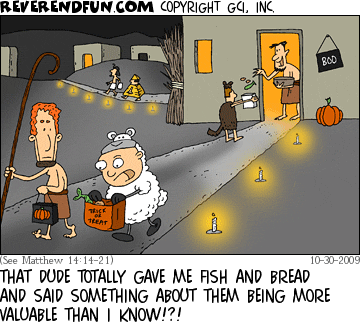
The people living at the time of Jesus certainly knew that men born blind do not immediately receive their sight (John 9:32), that five loaves and a few fish would not feed 5,000 people (John 6:14) or that men do not walk on water (Matthew 14:26).

Doubting Thomas said, “Unless I see in His hands the print of the nails, and place my hand in his side, I will not believe” (John 20:25, RSV). He refused to accept the testimony of the unbelievable event of the resurrection, but changed his mind when confronted face-to-face with the resurrected Christ. Thus we are not expected to believe the ridiculous, and neither were the people of biblical times.

The people living in those times were no less skeptical than we are today. It was the unavoidable, the inescapable, the irrefutable fact that caused them to believe. The natural order was interfered with as a miracle occurred. It is only the skepticism of modern man that caused him to deny that miracles occurred.

Taken from Answers to Tough Questions about the Christian Faith by Josh McDowell and Don Stewart.

Monday, November 23, 2009

Q & A - Does the Bible allow for the theory of evolution?

Hello youths! This is one of our most often asked questions, and it comes in various forms, such as, "Can a person be a Christian and believe in evolution?” or “Hasn’t science proven the theory of evolution, thus contradicting the Genesis account of creation?”

To answer this, we must first understand what we mean by the term evolution. If it is defined as simply “change” – as the development of an infant to an adult or a change within a kind, such as dog or cat – then this would pose no problem. This evolution, or developmental change within certain kinds, is completely consistent with Holy Scripture.

The problem is that the prevailing theory of evolution goes far beyond this. The theory states basically that complex elements have developed from simpler elements, and living organisms have sprung from non-living chemicals, by a chance association.

The theory of evolution is less of a scientific theory and more of a philosophy about the origin of life and the meaning of man.

The theory of evolution is contradictory to the biblical narrative of creation. The Genesis account records ten different times how God created plants and animals after their kind with no crossing of the kinds. Man was fully man at his creation, as was woman, with no long gradual period of development.

The idea of natural selection, or survival of the fittest, is at odds with the biblical teaching that all things were created good (Genesis 1:31). The Scriptures teach that everything was originally created perfect, and death and decay occurred when sin entered into the universe. This is opposed to the evolutionary concept of everything getting better.

Evolution not only contradicts the Bible, but it also contradicts some basic laws of science. For example, the second law or thermodynamics implies that left to itself, everything tends to become less ordered, not more ordered or “complex”.

This rule is an observation of the obvious: things grow old, run down and eventually die or decay. They lose their structure. The theory of evolution says that things develop their complexity and structure. This is not the case.

Evolution also says that changes or mutations are beneficial, while nature shows almost all variations are harmful. The theory contradicts observable phenomena.

Neither the theory of evolution nor the theory of special creation can be proven scientifically; that is, they cannot be repeated in a laboratory environment. Special creation happened once in the past, and evolution is too slow to observe.

Both theories are faith assumptions, and on the basis of the evidence one must choose one or the other. The Christian should not be embarrassed for believing the Genesis account of creation, since it not only fits better with observable facts but also was the view of the God-Man Jesus Christ (Matthew 19:1-6).

Taken from Answers to Tough Questions about the Christian Faith by Josh McDowell and Don Stewart.

Friday, November 13, 2009

You can know how to have victory over your enemy.

Hey youths! Can you really have victory over Satan every day? What happens if you fail? Satan wants you to sin so he can spoil your relationship with God. You need to remember four very important things that will help you have victory over Satan.

1. You don’t have to sin. Remember that the Lord Jesus already defeated Satan and sin when He died on the cross and rose again. The bible says, “Resist [stand against] the devil, and he will flee [run] from you” (James 4:7). You can choose to say no to sin through the strength of the Lord Jesus, who lives in you.

2. Remember that sin spoils your friendship with God. He will never leave you, but sin makes Him sad. Sin also blocks your prayers so that God will not answer.

3. You can make things right by confessing your sin to God. The bible says that if you agree with God about your sin, He is always fair and promises to forgive you. Then your friendship with God will be made right. Ask Him to help you not to sin that way again. You may also need to say “I’m sorry” to someone else who has been hurt by your sin.

4. Thank God for victory over Satan. Remember that Jesus is the one who makes you a winner.

The bible says, “Be strong in the Lord and in His mighty power” (Ephesians 6:10). How good it is to know deep inside that you can be a winner over Satan!

“But thanks be to God! He gives us the victory through our Lord Jesus Christ” 1 Corinthians 15:57

Taken from The Wonder Book by Child Evangelism Fellowship Inc

Wednesday, November 11, 2009

You can know you have an enemy.

Hey youths! Satan is our greatest enemy. The bible says that he was created by God as a beautiful angel. But he turned against God and wanted to destroy God’s plan. He was the one who tricked Eve and brought sin into the world. Sin ruined God’s beautiful creation.

Satan is also called the devil. From the beginning he wanted to stop God from keeping His promise to send a Saviour to die for the sin of the whole world. But Satan failed. Jesus defeated Satan when He died on the cross and came alive from the dead.

Satan hated God and he hates those who have trusted the Lord Jesus as their own personal Saviour.

Satan tried to make us do wrong things. He puts doubts and bad thoughts into our minds. He does not want us to love the Lord Jesus. If Jesus is your Saviour, you do not have to be afraid of Satan. The bible says, “The one [Holy Spirit] who is in you is greater than the one [Satan] who is in the world.” (1 John 4:4). Jesus is God; He is greater and more powerful than Satan. Someday Satan and all those who follow him will be thrown into the lake of fire where they will be punished forever and ever. Since Jesus lives in you, you can learn how to win over your enemy Satan.

“Be self-controlled and alert. Your enemy the devil prowls around like a roaring lion looking for someone to devour.” 1 Peter 5:8

Taken from The Wonder Book by Child Evangelism Fellowship Inc

Saturday, November 7, 2009

Q & A - Where do dinosaurs and other extinct animals fit into the biblical story?

Hello youths! Very few of the many species of animals are mentioned in the Bible. Genesis records only that God created all living creatures of the sea, of the earth, and of the sky, and labels them in the most general terms; cattle and creeping things and beasts of the earth and winged creatures.

Only those animals that are significant to human history are mentioned in the Bible specifically, such as cattle, oxen, goats, sheep (important to the economy), plus the specific list of clean and unclean animals in the Levitical law, etc. Many animals are not specifically named in the Bible, dinosaurs among them. (This includes the giraffe, elephant, shark, whale, platypus, kangaroo, etc).

Lack of mention means little, other than that they did not come into the history of man in a way significant or necessary to record. That dinosaurs existed is apparent from the fossil records of the great dinosaur beds, presumably preserved by a catastrophe, such as the flood.

Unless the sediments which entrapped them hardened quickly into stone, their bodies would have soon decomposed, but the remains that we have are whole bodies intact. A catastrophe such as the flood would explain having such remains.

Additional evidence for their existence, and at the same time as man, is the pictographs left in Africa and North America, and from the fossil evidence of human and dinosaur footprints in the same formation.

As to why and how they became extinct, we can only guess. We do know that Genesis records that when God finished creation, everything was very good. When the Fall occurred, death and destruction entered the universe.

Eventually, corruption was so widespread that God destroyed all but Noah's family and two of every kind of living creature, which he caused to come to Noah for safekeeping on the ark.

It is possible that God left out some of the earth animals, that He didn't cause them to come to Noah, such as the dinosaurs. But the Bible says, "Two of every kind shall come to you to keep them alive."

We can guess that either dinosaurs didn't make it onto the ark because, plausibly, God intended them to become extinct at that time, or that because of climatic conditions after the flood, they failed to reproduce in sufficient numbers and died out. We simply don't have enough data to go beyond guessing at this point.

Taken from Answers to Tough Questions about the Christian Faith by Josh McDowell and Don Stewart.